When Metrics Cause Mayhem
March 17, 2026
How Poor KPIs Drive Anti-Lean Behaviors
There is an old, undeniable truth in business: Tell me how you measure someone, and I will tell you how they will behave.
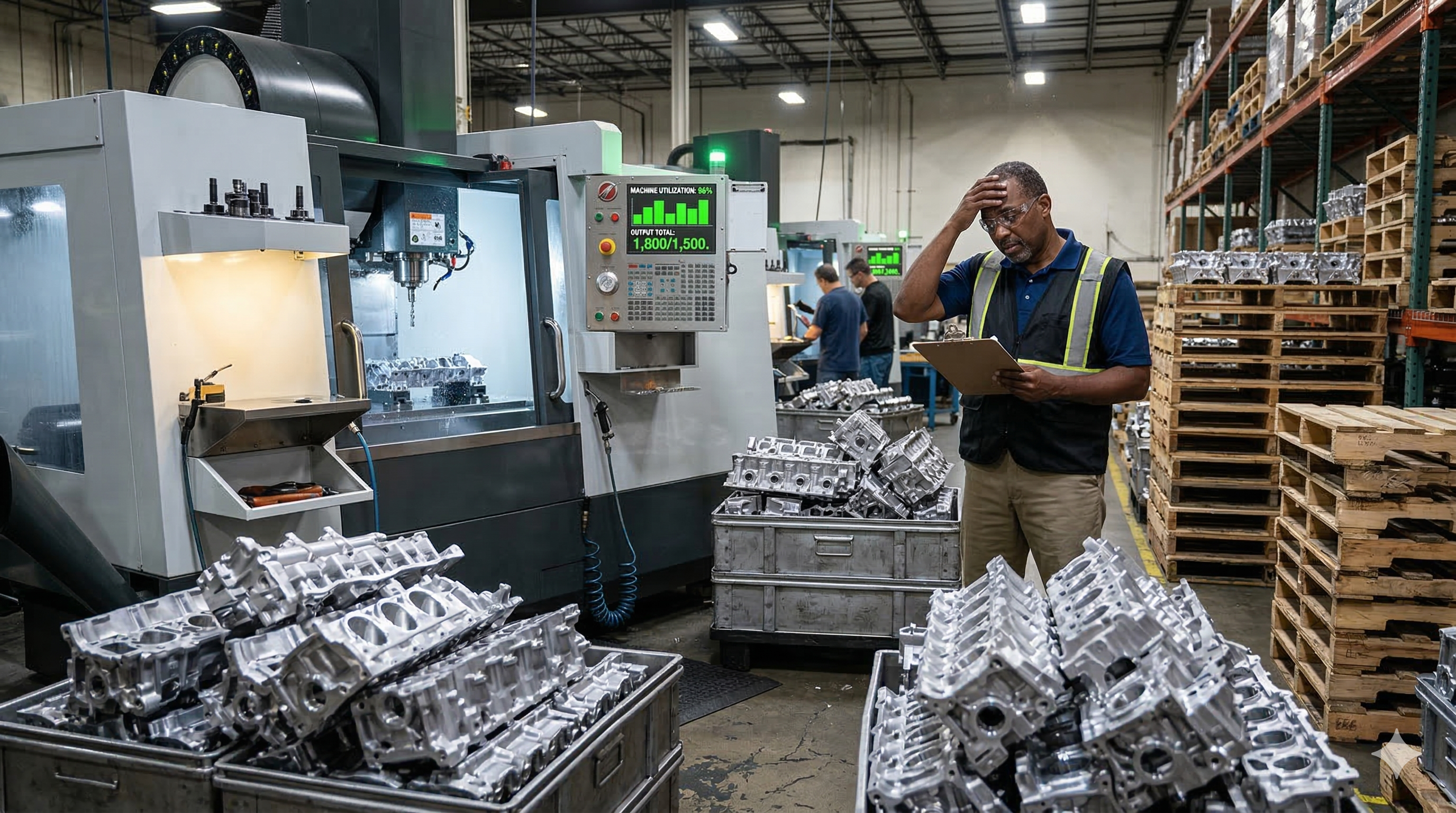
Imagine a typical manufacturing plant. The executive team has mandated that to maximize return on capital, all heavy machinery must hit a 95% utilization rate. The Plant Manager’s bonus is tied to this metric. The supervisors are graded on it daily.
So, what does the team do? They keep the machines running. They run massive batch sizes to avoid downtime from changeovers. If they don't have orders for a specific part, they build it anyway just to keep the spindle turning. They hit their 95% utilization target. High-fives all around, right?
Wrong. By measuring and rewarding local efficiency, the executive team has accidentally incentivized the team to sabotage the company’s profitability and cash flow.
The Illusion of Efficiency
When you prioritize machine utilization over customer demand, you trigger a chain reaction of operational mayhem.
First, the plant overproduces parts that no one has ordered yet. Those parts get put into boxes, and those boxes get put onto racks. Suddenly, your warehouse is overflowing. You have to rent off-site storage. You have to pay material handlers to move this excess inventory around.
But the most dangerous consequence is invisible to the naked eye: Cash flow. That excess inventory represents millions of dollars of tied-up working capital. It is cash sitting on a shelf gathering dust, at risk of becoming obsolete, rather than being reinvested into the business.
The C-suite looks at the P&L and wonders why cash is so tight, while the Plant Manager proudly points to a dashboard showing the machines are running flawlessly.
The Systems-Level Audit: Are You Paying Your Team to Fail?
If you are a CEO, a VP of Operations, or sitting on a Board of Directors, you cannot just look at what the numbers are. You have to understand how the pursuit of those numbers alters human behavior on the floor.
Many well-intentioned companies launch Lean initiatives—focused on flow, reducing waste, and pulling to customer demand—but leave their legacy mass-production KPIs in place. You cannot ask a supervisor to reduce batch sizes for Lean if their annual review is still based on cost per unit, which mathematically penalizes them for doing extra changeovers.
When your metrics fight your methodology, the metrics will win every time.
3 Metrics to Simplify and Align Your Strategy
If you want to stop the mayhem, you have to change the scoreboard. True Lean transformation requires stripping away the clutter of vanity metrics and focusing on what actually drives enterprise value.
- Stop Measuring Machine Utilization (Everywhere) and Start Measuring Flow and Lead Time: Unless a machine is the absolute bottleneck (the constraint) of your entire facility, maximizing its utilization is pure waste. Instead, measure how long it takes a single product to get from raw material to a finished, invoiceable good. Optimize for velocity, not busyness.
- Stop Measuring Local Cost Per Unit and Start Measuring Inventory Turns: Local cost-per-unit metrics encourage departments to build massive batches to spread out setup costs and sometimes inspection costs, which bloats inventory. Shift the focus to Inventory Turns. This rewards leaders for freeing up working capital and building only what the customer actually wants, when they want it.
- Stop Measuring Output Volume and Start Measuring Schedule Attainment: Rewarding a shift for producing 1,200 widgets when the schedule only called for 1,000 is not a victory; it is overproduction. Schedule attainment measures discipline. Did we make exactly what we planned to make, in the right sequence, with perfect quality?
The Bottom Line
A dashboard cluttered with 50 different KPIs isn't a strategy. It is a symptom of a leadership team that doesn't know what's truly important.
Complexity hides waste. Simplicity exposes it. Before you launch your next big continuous improvement initiative, take a hard look at your incentive structures. Make sure you aren't accidentally paying your team to build the very roadblocks you are trying to remove.
Call to Action
Have you ever seen a KPI drive the exact wrong behavior in your organization? What was the metric, and how did the team game it?
Let's discuss in the comments below. And if you are an executive looking to realign your metrics with true profitability, keep an eye out for my upcoming book, Manufacturing Simplicity.
#ManufacturingSimplicity #LeanManufacturing #ContinuousImprovement #ChangeManagement #KPIs