The Cultural Factor
September 30, 2025
Here's an excerpt I extracted from the Manufacturing Simplicity book. I have dedicated a full chapter to developing a lean culture. Check out this introduction and let me know what you think.
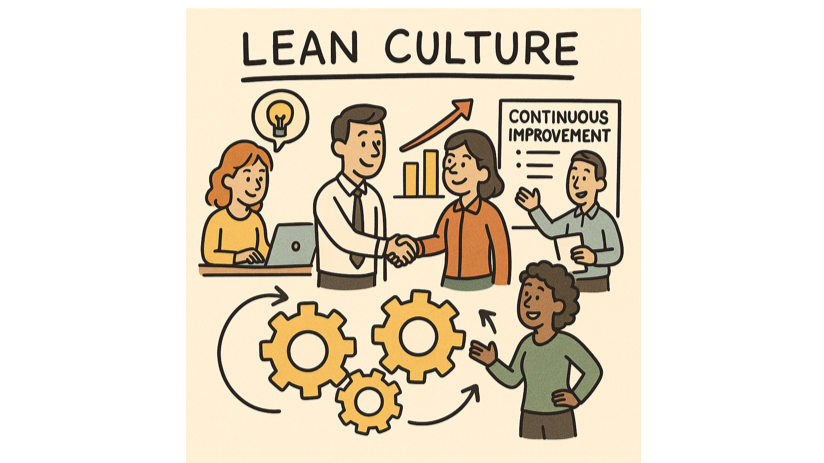
"A lean culture thrives on simplicity. It encourages open dialogue, transparency, and continuous learning, reducing organizational noise and friction. Employees who clearly see how their daily activities contribute to larger goals are empowered to identify unnecessary complexity and proactively eliminate it. This simplicity, embedded culturally, doesn't just streamline processes; it enhances morale, innovation, and responsiveness.
Throughout this chapter, we'll explore how developing this kind of culture, one rooted in simplicity and employee engagement, is essential to lasting lean transformation. We'll discuss practical steps to engage your teams effectively, reinforcing behaviors that continuously simplify processes and create a more responsive, agile organization.
In my work turning around or simply improving businesses, I've witnessed firsthand the power of lean done right, as well as the devastating consequences of lean gone wrong. The list of companies that have stumbled while trying to implement lean is, unfortunately, a long one. Too often, I see a familiar pattern: an executive reads a book, hires a consultant (often inexperienced), and then focuses obsessively on a single tool, usually 5S. They drill it into the workforce for years, even when it doesn't align with the company's immediate needs. The employees get fed up with being told to stop everything and clean, the management team gets frustrated with the ongoing consulting fees without seeing bottom-line impact, and eventually, the whole initiative collapses. I saw this very scenario play out in the US Midwest. In South America, I encountered another company proudly proclaiming its lean journey. But when we went to the gemba (the place where the work happens), it was clear they were far from lean. Inventory was piled high, employees seemed to be doing everything but adding value, and despite struggling with unreliable suppliers, machine downtime, and quality issues, they'd chosen to implement Kanban with ridiculously high inventory levels at each "supermarket." The employees I spoke with were understandably frustrated; they were already fighting daily operational fires, and now they had to wrestle with a confusing new Kanban card system that was not adding any value. I do realize Kanban is a great tool, and I have implemented it many times. My point is that there is a right timing for each technique to be implemented.
These stories, though from different continents and industries, share common threads. The lean implementations were tool-focused, not culture-focused. The chosen tools weren't aligned with the company's most pressing needs. And, most critically, the workforce wasn't trained, motivated, or engaged. Both companies mentioned, by focusing on the doing rather than the being of lean, not only failed in their transformations but also gave lean a bad name, making my subsequent work that much harder. This introduction is not meant to point fingers; the intention is to highlight that you don't do lean; you become lean. This requires a fundamental shift in mindset and behavior at every level. Think about the people in your organization who typically identify problems, develop solutions, and drive improvements. Chances are, it's a small group. These "problem solvers" are invaluable, but they often become overwhelmed, working long hours, burning out, and ultimately becoming a bottleneck for change. Now, imagine a different scenario: what if every employee in your company could identify waste? What if they were equipped with lean tools and knew how to use them? What if they were constantly measuring relevant metrics and taking action when things went wrong? What if they proactively formed teams to make things better and celebrated their successes? What kind of results would you see? That's the power of a true lean culture. It's contagious, it's rewarding, and it's achievable. This chapter will explore how to build that culture, the very heart of any successful lean transformation."
What could your organization achieve if everyone, not just a few problem solvers, had the skills and confidence to drive change?
#Lean #Leadership #ContinuousImprovement #Culture #OperationalExcellence #Kaizen