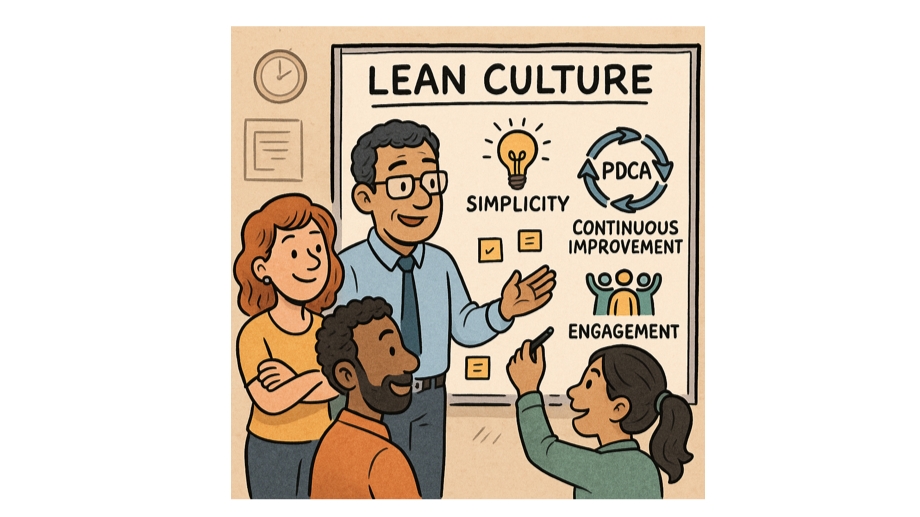
Leadership Behavior is The Foundation of a Lean Culture
October 7, 2025
Most "lean transformations" do not fail because people used the wrong tool. They fail because leaders behaved in ways that made the tools meaningless. People copy what leaders do, not what leaders say. If leaders chase output today and ignore learning tomorrow, the organization will do the same. If leaders reward firefighting and overlook prevention, the organization will do the same. Culture is a mirror, and leadership is the face in front of it.
Lean culture starts with leadership behavior that makes problems visible, treats people respectfully, and insists on learning daily. Tools help. Behavior decides.
Tools versus behavior
5S, Kanban, A3s, and value stream maps are useful. They are also powerless without the behaviors that give them purpose. A shadow board that no one audits is decoration. A visual KPI board that no one visits is wallpaper. An A3 without coaching is a form to fill out. When leaders change how they show up, the same tools become teaching aids, speed feedback, and build shared ownership.
Think of leadership behavior as the operating system. Tools are the apps that run on it. A weak operating system crashes even good apps.
Five leadership behaviors that build lean culture
1) Show up at the gemba, and show up well. Go where the work happens. Go daily. Arrive with curiosity, not with a lecture. Look for flow, not for fault. Ask people to show you the obstacles that slow them down. When you see a problem, help remove it. The message is simple. "Your work matters. Your ideas matter. I am here to learn and to help."
2) Make problems visible and safe to surface. Post the vital few KPIs where everyone can see them. Use red and green only. Red means "we need help." Then respond fast when red appears. Punish hiding, not honesty. Celebrate transparency. The faster a problem is seen, the cheaper it is to fix. Visibility without safety creates fear. Safety without visibility creates drift. You need both.
3) Ask better questions. Replace "Who is to blame?" with "What is the standard, and what is the gap?" Replace "Why did you do that?" with "What did the process allow or encourage?" Replace "Give me a quick answer" with "What facts would help us understand cause and effect?" Questions teach people what matters. Over time, your questions become their inner voice.
4) Coach PDCA, do not skip to solutions. Plan. Do. Check. Act. Leaders who jump from Plan to Do create motion without learning. Leaders who insist on Check and Act create knowledge. Stand in front of a simple board, review yesterday's results, and ask three questions. What happened. Why. What will we try next. Then come back tomorrow and ask what we learned. This rhythm builds capability faster than any class.
5) Protect time for improvement. No time means no improvement. Block small windows every day for problem solving, standard work audits, and skill building. Make it part of Leader Standard Work. If the calendar never shows improvement time, your culture will never show improvement either.
Behaviors to stop
- Driving by email and dashboard alone. Go see.
- Treating misses as personal failures. Treat them as information.
- Launching tools without clarifying purpose and standards.
- Rewarding heroic recovery more than quiet prevention.
- Overloading teams with goals, then blaming them for lack of focus.
What Leader Standard Work looks like
A simple template beats a complicated plan that no one follows. Here is a pattern that works at many sites.
- Daily, 30 to 60 minutes. Gemba walk on two value streams. Review one KPI board with the team. Ask what blocked flow yesterday. Agree on one action and an owner. Log a short note.
- Daily, 10 minutes. Stand-up with your direct team. Yesterday's wins, today's risks, expected support.
- Weekly, 45 minutes. Audit one standard work sheet with the owner. Look for clarity, training status, and obstacles. Capture actions.
- Weekly, 30 minutes. Coach one A3 or problem-solving effort. Focus on grasping the situation and testing causes before countermeasures.
- Monthly, 60 minutes. Walk the improvement boards. Remove roadblocks, recognize progress, retire finished KPIs, and reset targets that are now the new baseline.
Keep it visible. Post your Leader Standard Work where your team can see it. Invite feedback. When leaders hold themselves to standards, everyone else will too.
How leaders use KPIs without killing trust
- Choose few, explain why. Every KPI should link to a customer promise or a strategic gap.
- Respond fast. If red appears and leaders are silent, boards will go stale.
- Coach the story. Ask teams to present the trend, cause, and next experiment. Numbers are a plot. People write the chapters.
- Move the stake. When a target is met repeatedly, make it the new standard. Set the next target slightly higher. This is how you create steady pressure without panic.
A simple playbook for the first 30 days
Week 1. Pick one value stream. Clarify three KPIs, a daily huddle time, and a safe rule for red. Red means "leaders help within the hour."
Week 2. Start your own Leader Standard Work and keep it visible. Do one daily gemba walk. Ask only learning questions.
Week 3. Coach two small PDCA cycles. Document the learning on one page. Share the stories at the huddle.
Week 4. Recognize two people in public for surfacing problems early and for improving a standard. Move one KPI target forward by a small, agreed step.
These four weeks will do more for your culture than a year of posters or slogans and banners.
Common traps and how to avoid them
- Tool Chasing. Resist the urge to "roll out" a tool company-wide before behaviors take root. Pilot, learn, then scale.
- Metric overload. If everything is important, nothing is. Three to five KPIs per team is plenty.
- Blame reflex. When heat rises, leaders often revert to pressure. Slow down. Ask for the standard and the gap. Fix the system, not the person.
- Automation too soon. Establish manual boards and habits first. Then automate what is stable. Better to be roughly right and learning than precisely wrong at scale.
The promise you make as a leader
Lean is not something you tell people to do. It is who you become in front of them, every day. Show up where the work happens. Make problems safe to see. Ask questions that build thinking. Coach PDCA. Protect time for improvement. When you do these things, tools become powerful, and people become proud of the results they create.
Lean culture is not a program. It is a leadership habit. Start with your behavior, and the culture will follow. Then the numbers will follow. Then the wins will stick. One day at a time. One walk at a time. One good question at a time.
Sources & Inspiration: The ideas in this article draw from classic lean thinkers (Deming, Ohno, Liker, Shingō), personal experience in lean transformations, and modern insights from the Lean Enterprise Institute and lean leadership literature. They are reflected in the upcoming book "Manufacturing Simplicity".